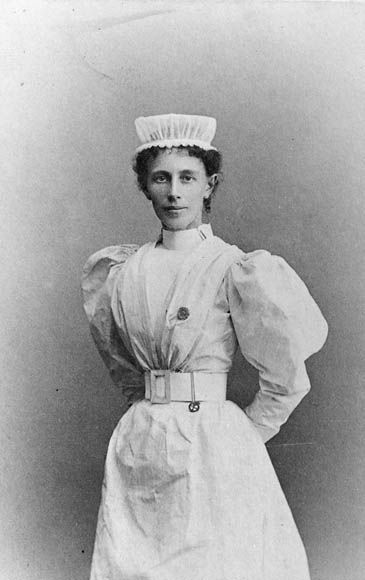
Georgina Pope, about 1898A. G. Pittaway, about 1898. Public domain. Wikimedia Commons. Image source
Georgina Pope leads Canada's first military nurses
1899 to 1908 · Georgina Fane Pope (1862 to 1938)
Georgina Pope was born in Charlottetown, Prince Edward Island, in 1862. She trained as a nurse at Bellevue Hospital in New York and worked in hospitals in the United States.
In 1899 Canada sent troops to the South African War. Pope was chosen to lead the first small group of Canadian nurses who went with them. They cared for soldiers sick with typhoid and wounded in battle, often in tents and with few supplies.
For her service she received the Royal Red Cross, a British award for military nursing.
In 1908 Pope became the first Matron of the permanent Canadian Army Medical Corps nursing service. Canadian military nurses were called Nursing Sisters, and they held officer rank, which was unusual for women at the time. Thousands more served in the First World War.
Pope's story is a reminder that Canadian nurses have long worked in hard places and that leadership is part of nursing at every level.
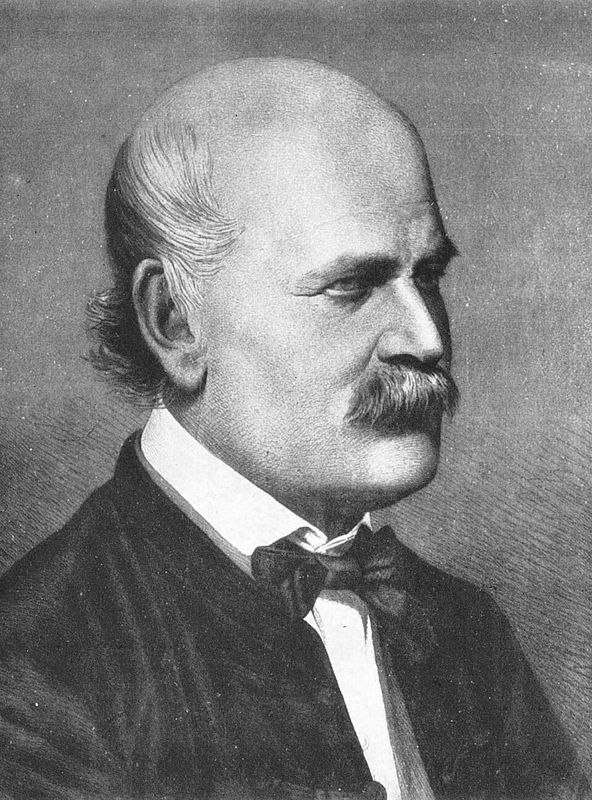
Ignaz Semmelweis, 1860after an engraving by Jenő Doby, 1860. Public domain. Wikimedia Commons. Image source
Semmelweis and the washbasin
1847 · Ignaz Semmelweis (1818 to 1865)
In the 1840s the Vienna General Hospital had two maternity clinics. In one, doctors and medical students delivered babies. In the other, midwives did. Far more mothers died of childbed fever in the doctors' clinic, and women begged not to be sent there.
Ignaz Semmelweis, a young doctor, wanted to know why. In 1847 a colleague died after being cut by a scalpel during an autopsy, with an illness much like childbed fever. Semmelweis realized the doctors often came straight from autopsies to deliveries. He believed something on their hands was carrying the disease.
He ordered everyone to wash their hands in a chlorinated lime solution before examining patients. Deaths in his clinic dropped sharply within months.
Many senior doctors rejected his idea, partly because germs had not yet been proven to cause disease. Semmelweis died in 1865, before his work was widely accepted.
Today hand hygiene is the single most important way to prevent infections in health care.