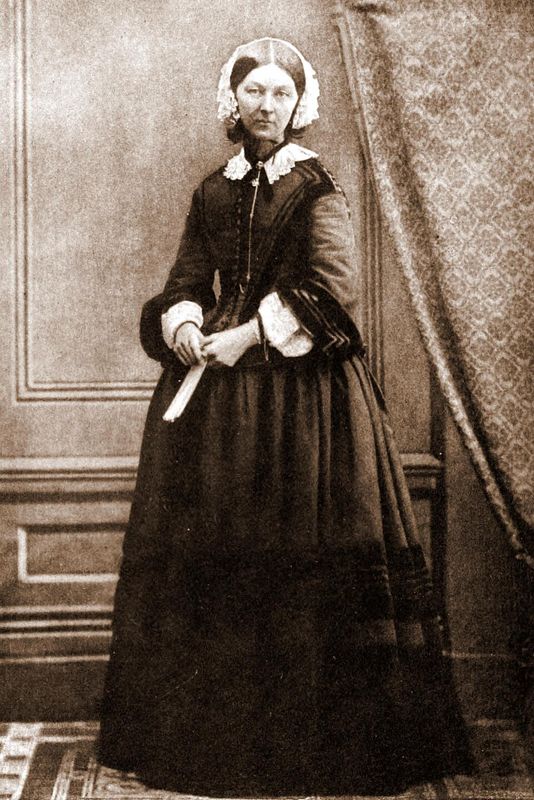
Florence Nightingale, about 1858Henry Hering, about 1858. Public domain. Wikimedia Commons. Image source
Florence Nightingale counts the dead, then changes nursing
1854 to 1860 · Florence Nightingale (1820 to 1910)
In October 1854 Florence Nightingale left London with a group of 38 nurses for the British Army hospital at Scutari, across the water from Constantinople. The war in Crimea was going badly, and so was the care. Wards were crowded, drains were blocked and supplies were short.
Nightingale and her nurses cleaned, organized laundry and food, and checked on patients at night. Soldiers called her the Lady with the Lamp.
She also kept careful records. Back in England she used them to show that far more soldiers had died of preventable diseases like cholera and typhus than of their wounds. She drew her numbers as a circular chart so politicians could see the problem at a glance. In 1858 she became the first woman elected to the Royal Statistical Society.
In 1859 she published Notes on Nursing, a practical guide to fresh air, cleanliness, light and observation. In 1860 the Nightingale Training School for nurses opened at St Thomas' Hospital in London.
Today International Nurses Day is held on 12 May, her birthday.
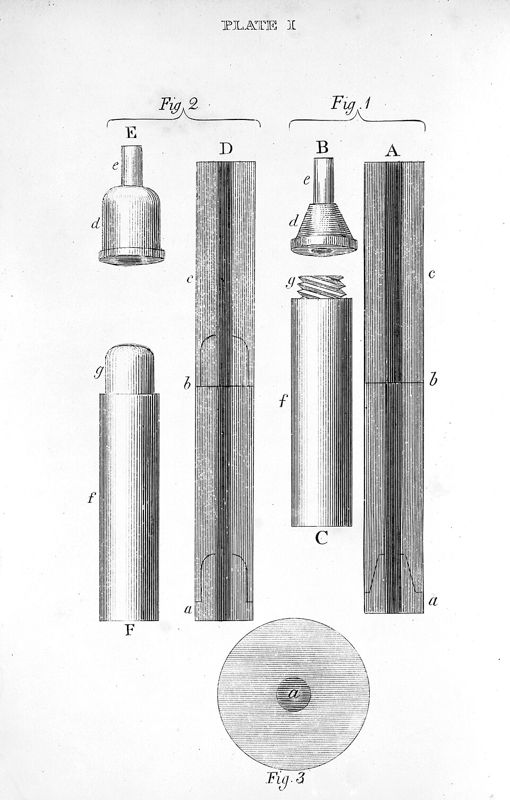
A Laennec-style wooden stethoscope, 1819Science Museum, London, 1819. CC BY 4.0. Wellcome Collection, via Wikimedia Commons. Image source
A rolled-up paper becomes the stethoscope
1816 to 1819 · René Laennec (1781 to 1826)
In 1816 René Laennec was a doctor at the Necker Hospital in Paris. Doctors then listened to the chest by pressing an ear directly against the patient. Laennec found this awkward with a young woman whose heart he needed to check.
He remembered children sending sounds along a wooden beam by tapping one end. So he rolled a sheaf of paper into a tight tube, put one end on her chest and the other to his ear. The heart sounds came through louder and clearer than he expected.
Laennec then made wooden tubes and spent years matching what he heard to what he later found at autopsy. In 1819 he published a book on listening to the chest, which he called mediate auscultation. It described sounds still taught today, such as crackles.
His stethoscope had one earpiece. Two-earpiece models with rubber tubing came in the 1850s.
Laennec died in 1826 of tuberculosis, a disease he had helped doctors recognize with his instrument. Every set of lung sounds a nurse charts goes back to his paper tube.